Development review · not productionStage 6 · Step 7 manual-review set. Hidden from the Field Guide navigation. No canonical route, IA or production implementation is changed by this page.
Stage 6 visual-prototype review
Direct inspection set for the seven validated entries. Quick Reference is shown as a comparative retrieval system; Portable Reference is shown as a standalone working reference. Type labels provide semantic identity; no Principle/Guideline numbering is used. Dimensions below are prototype constraints, not final channel specifications.
Quick normal · 1180×900 contextQuick narrow · 390×844Portable standard · 640×800Portable small · 360×640Print-like · 620×874 / A6 proportion
A · Quick Reference — comparative retrieval context
Review the seven together in their normal collapsed state. The retrieval flow is: scan → identify candidate guidance → open More context → confirm applicability/scope → open detailed guidance if needed. Expanded rows below are disclosure states, not the default browsing state.
Normal retrieval constraint
Design guidance
Choose the guidance that best matches the decision you are making.
7 results
Scope
PRINCIPLE
Use AI only where it adds user value
Use AI when its capabilities create meaningful value for the user or task; prefer a simpler non-AI approach when it solves the need as well or better.
More context
When it matters
Decide early whether AI is needed, or whether simpler rules or a manual process would solve the user’s problem as well or better.
Scope boundary
Deciding whether AI fits the product is different from explaining the benefit of an AI feature after that choice has been made.
Introduce AI gradually using familiar mental models
Build understanding over time by starting from familiar concepts, setting early expectations, and revealing additional AI capabilities when they become relevant.
Implementation patterns
More context
When it matters
People are encountering the AI for the first time
The interaction model is unfamiliar
The feature set is complex
Capabilities become relevant gradually over time
Scope boundary
Onboarding does not replace later notification when the system materially changes.
For Atlassian Rovo delegated-work experiences, make scope, progress, risks, and intermediate state visible enough for the person to course-correct or intervene before completion.
Lifecycle oversight — not only a pre-action approval gate.
More context
When it matters
Use for delegated or proactive multi-step work where AI can advance tasks without continuous direct manipulation.
Important distinction
Delegated oversight spans the work lifecycle; it is not just a one-time confirmation before execution.
Define AI success around user consequences and outcome tradeoffs
Define success by user outcomes; explicitly choose tradeoffs among false positives, false negatives, and longer-term effects rather than optimizing a model metric alone.
Product consequences of metric/threshold choices — not a general model-evaluation rule.
More context
When it matters
Use when product metrics or thresholds shape outcomes people experience.
Examples
Classification
Ranking
Recommendation
Detection
Decision support
Scope boundary
This is not a general model-evaluation handbook. The design concern is the connection between metric choices and human consequences.
Each bounded prototype must stand alone outside website navigation. Guidance and Implementation Pattern share one family; Pattern changes semantic hierarchy through Mechanism + Implements broader guidance.
Introduce AI gradually using familiar mental models
Core
Build understanding over time by starting from familiar concepts, setting early expectations, and revealing additional AI capabilities when they become relevant.
Use when
People are encountering the AI for the first time
The interaction model is unfamiliar
The feature set is complex
Capabilities become relevant gradually over time
Scope boundary
Onboarding does not replace later notification when the system materially changes.
For Atlassian Rovo delegated-work experiences, make scope, progress, risks, and intermediate state visible enough for the person to course-correct or intervene before completion.
Use when
Use for delegated or proactive multi-step work where AI can advance tasks without continuous direct manipulation.
Do not confuse
Delegated oversight spans the work lifecycle; it is not just a one-time confirmation before execution.
Scope boundary
The underlying concern can inform comparison elsewhere, but the Rovo prescription is not universal.
Define AI success around user consequences and outcome tradeoffs
Core
Define success in terms of user outcomes. Explicitly choose tradeoffs among false positives, false negatives, and longer-term effects rather than optimizing a model metric in isolation.
Use when
Use when product metrics or thresholds shape outcomes people experience.
Examples
Classification
Ranking
Recommendation
Detection
Decision support
Scope boundary
This is not a general model-evaluation handbook. The design concern is the connection between metric choices and human consequences.
Review annotation · Make delegated work observable and interruptible · 360×640
GUIDELINEATLASSIAN ROVO · PLATFORM-SPECIFIC
Make delegated work observable and interruptible
Core
For Atlassian Rovo delegated-work experiences, make scope, progress, risks, and intermediate state visible enough for the person to course-correct or intervene before completion.
Use when
Use for delegated or proactive multi-step work where AI can advance tasks without continuous direct manipulation.
Do not confuse
Delegated oversight spans the work lifecycle; it is not just a one-time confirmation before execution.
Scope boundary
The underlying concern can inform comparison elsewhere, but the Rovo prescription is not universal.
Review annotation · Define AI success around user consequences and outcome tradeoffs · 360×640
GUIDELINE
Define AI success around user consequences and outcome tradeoffs
Core
Define success in terms of user outcomes. Explicitly choose tradeoffs among false positives, false negatives, and longer-term effects rather than optimizing a model metric in isolation.
Use when
Use when product metrics or thresholds shape outcomes people experience.
Examples
Classification
Ranking
Recommendation
Detection
Decision support
Scope boundary
This is not a general model-evaluation handbook. The design concern is the connection between metric choices and human consequences.
Review annotation · Define AI success around user consequences and outcome tradeoffs · Print-like
GUIDELINE
Define AI success around user consequences and outcome tradeoffs
Core
Define success in terms of user outcomes. Explicitly choose tradeoffs among false positives, false negatives, and longer-term effects rather than optimizing a model metric in isolation.
Use when
Use when product metrics or thresholds shape outcomes people experience.
Examples
Classification
Ranking
Recommendation
Detection
Decision support
Scope boundary
This is not a general model-evaluation handbook. The design concern is the connection between metric choices and human consequences.
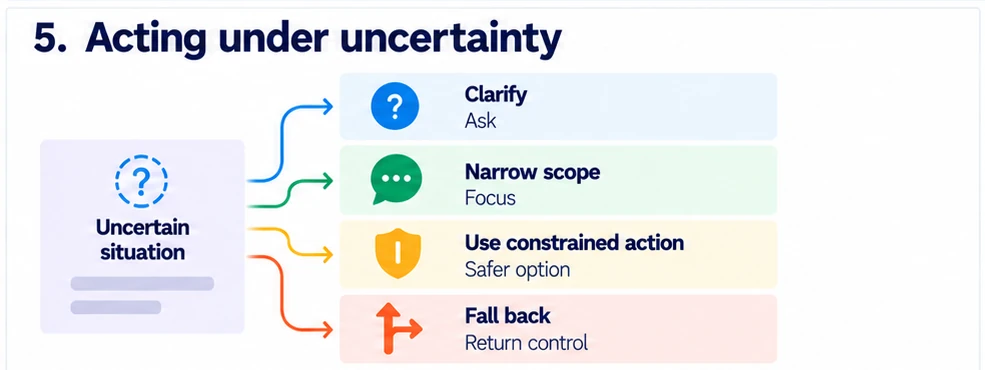
D · Acting under uncertainty — optional visual comparison
Same Portable constraint, side by side. The right-hand treatment keeps the mandatory 640×800 Portable Reference intact and places the exact approved Stage 5 visual immediately below it as an optional companion module. The visual is not redrawn or modified.
Review annotation · Portable Reference · without visual
GUIDELINE
Clarify or narrow scope when the AI is uncertain
Core
When the AI lacks enough information or confidence, ask for clarification, constrain the action, or use a safer fallback instead of overreaching.
Use when
The request is ambiguous or incomplete
The task is open-ended or delegated
Acting incorrectly under low confidence would matter
Do not confuse
Acting under uncertainty is different from communicating uncertainty. The guidance changes the action the system takes.
Implementation patterns
Disambiguate before acting · Elicit preferences to reduce cold-start uncertainty · Fall back to a safer or simpler strategy
See example →Optional companion module · exact approved Stage 5 composition
At 640×800 the visual does not fit inside the bounded Portable card without displacing mandatory content. The base card therefore remains visual-free; the approved visual is shown as an adjacent optional companion module rather than being forced into the card.
Manual-review checklist
Step 7 manual inspection has passed subject to the optional-visual overflow correction shown above. Review this corrected comparison as the final representation check.
Quick list scans comparativelyPrinciple / Pattern cues subordinate but legibleRovo qualification visible without dominationCorrection ≠ feedback noticeableActing ≠ communicating uncertainty noticeableProvenance discoverable but secondaryFull guidance & sources discoverableAI-success remains portable at bounded sizesOptional visual earns or does not earn its space