Same Rulebook, Different Rules
Designing interaction rules for humans and AI agents in AI-first platforms.
 Designing interaction rules for humans and AI agents in AI-first platforms
For most of software history, the roles were relatively clear.
Humans acted. Software responded.
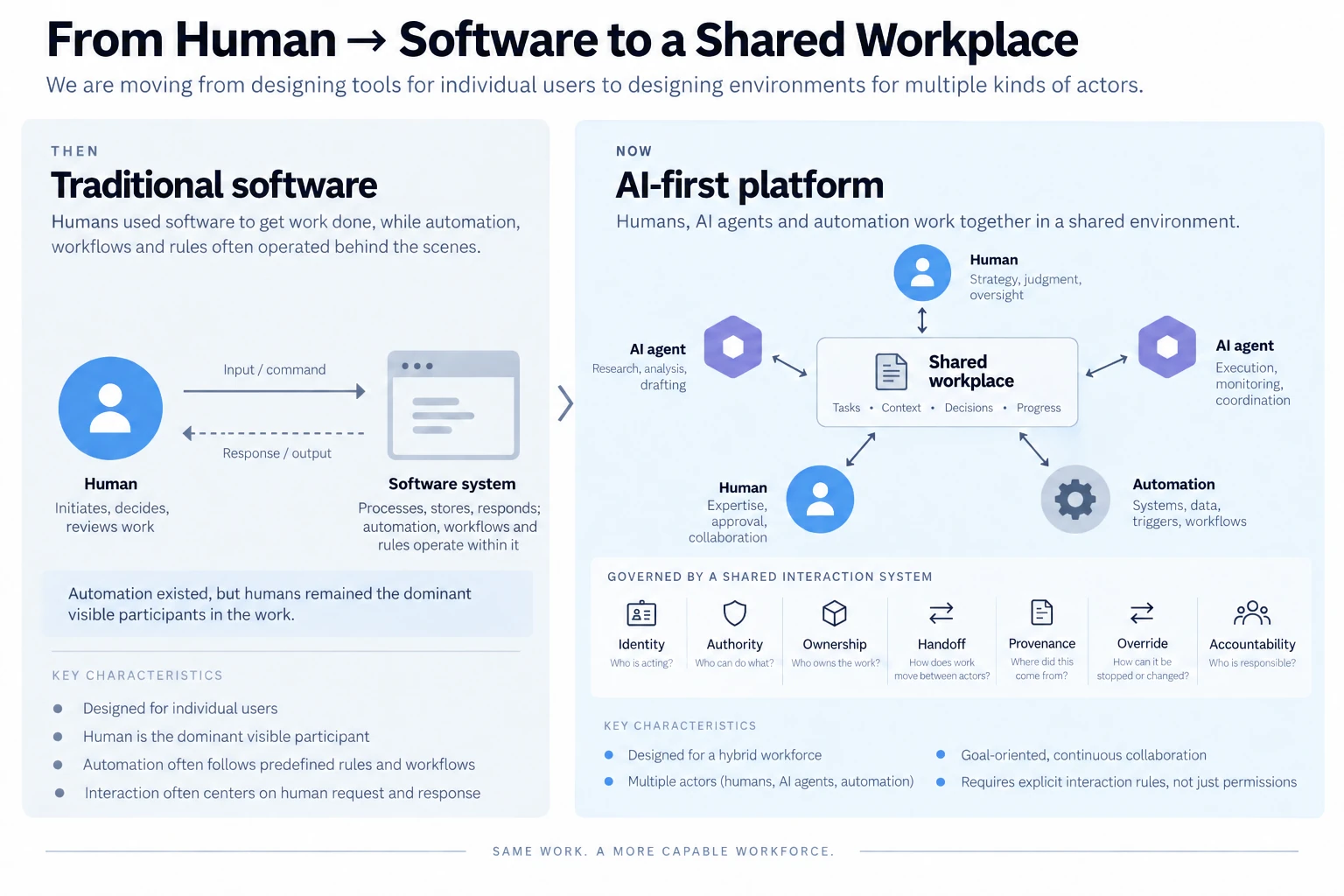
A person clicked a button, submitted a form, changed a record, assigned a task or sent a message. Even when automation existed behind the interface, the human remained the obvious actor around whom the system was designed.
AI-first platforms are beginning to disturb that assumption.
An AI agent can now participate in a conversation, monitor work, create tasks, update records, draft documents, trigger workflows, hand work to another agent, escalate something to a person and, increasingly, pursue goals without someone directing every individual step.
Microsoft now allows agents to appear in Teams conversations and participant lists. Its Channel Agent is positioned as an additional project teammate. Salesforce similarly describes Agentforce in Slack as something employees can engage with “just like another teammate,” while its more recent Agentforce Coworker is explicitly positioned as an autonomous AI teammate capable of taking action across enterprise systems. (Microsoft Support, Salesforce)
This sounds like a natural progression of collaboration software.
But it introduces a design problem that we may be underestimating.
What are the rules when humans and AI agents begin occupying the same work environment?
Not simply the security rules governing what an agent can access.
Not the system prompt telling an agent how to behave.
Not the workflow describing how a process moves from A to B.
And not just the approval gates inserted before an autonomous action.
The larger question is whether AI-first platforms need something closer to an interaction rulebook: a coherent set of rules governing how different kinds of actors initiate, coordinate, modify, delegate, challenge and account for work.
And if they do, one principle becomes important:
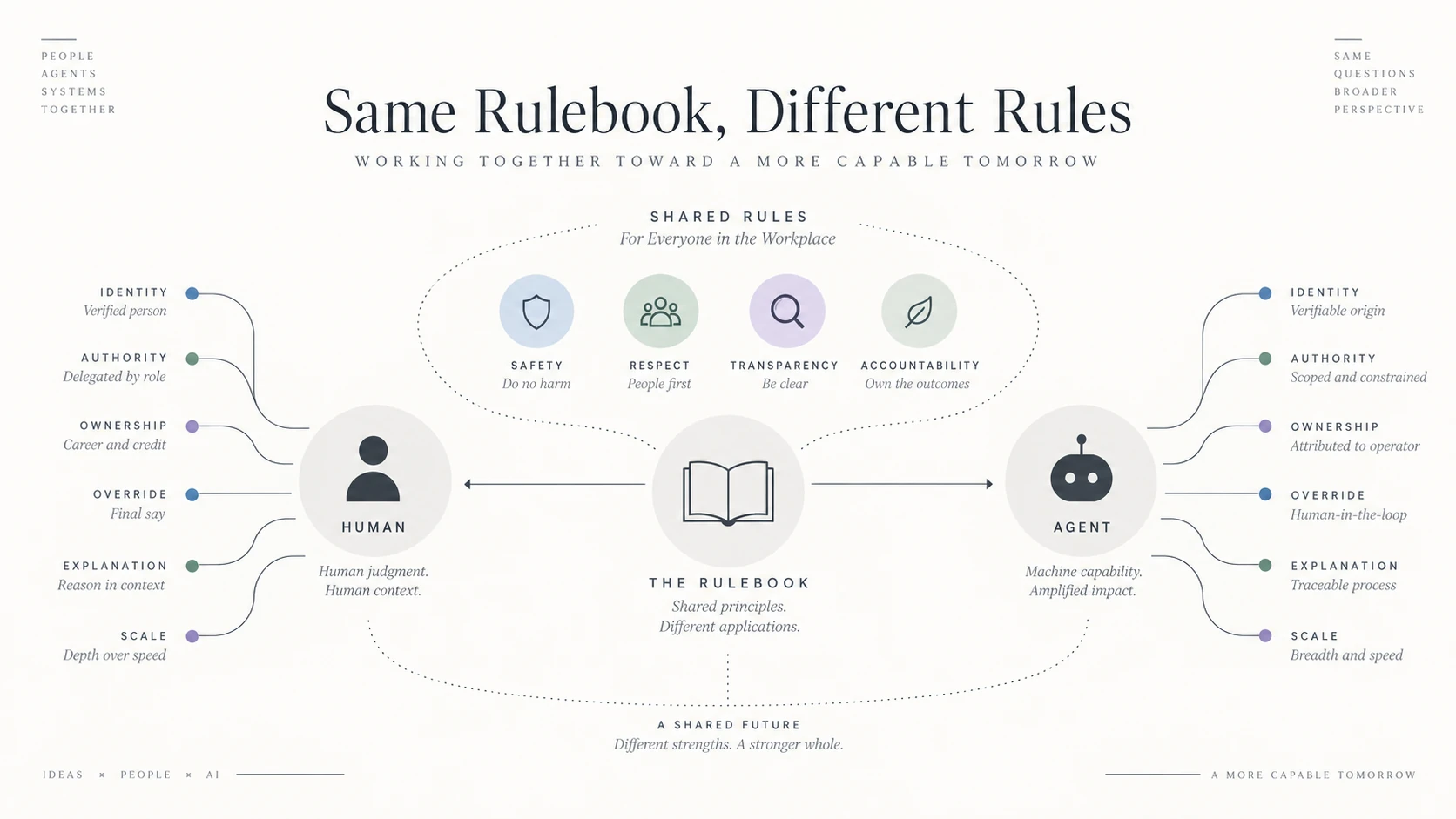
Same rulebook. Different rules.
Adding an AI agent to a workspace is not the same as adding another employee
 There is an appealing simplicity to describing AI agents as coworkers.
It helps explain what is changing. Instead of opening an AI tool, entering a prompt and taking the output elsewhere, the AI becomes embedded in the place where work already happens.
The metaphor is useful.
But taken literally, it becomes misleading.
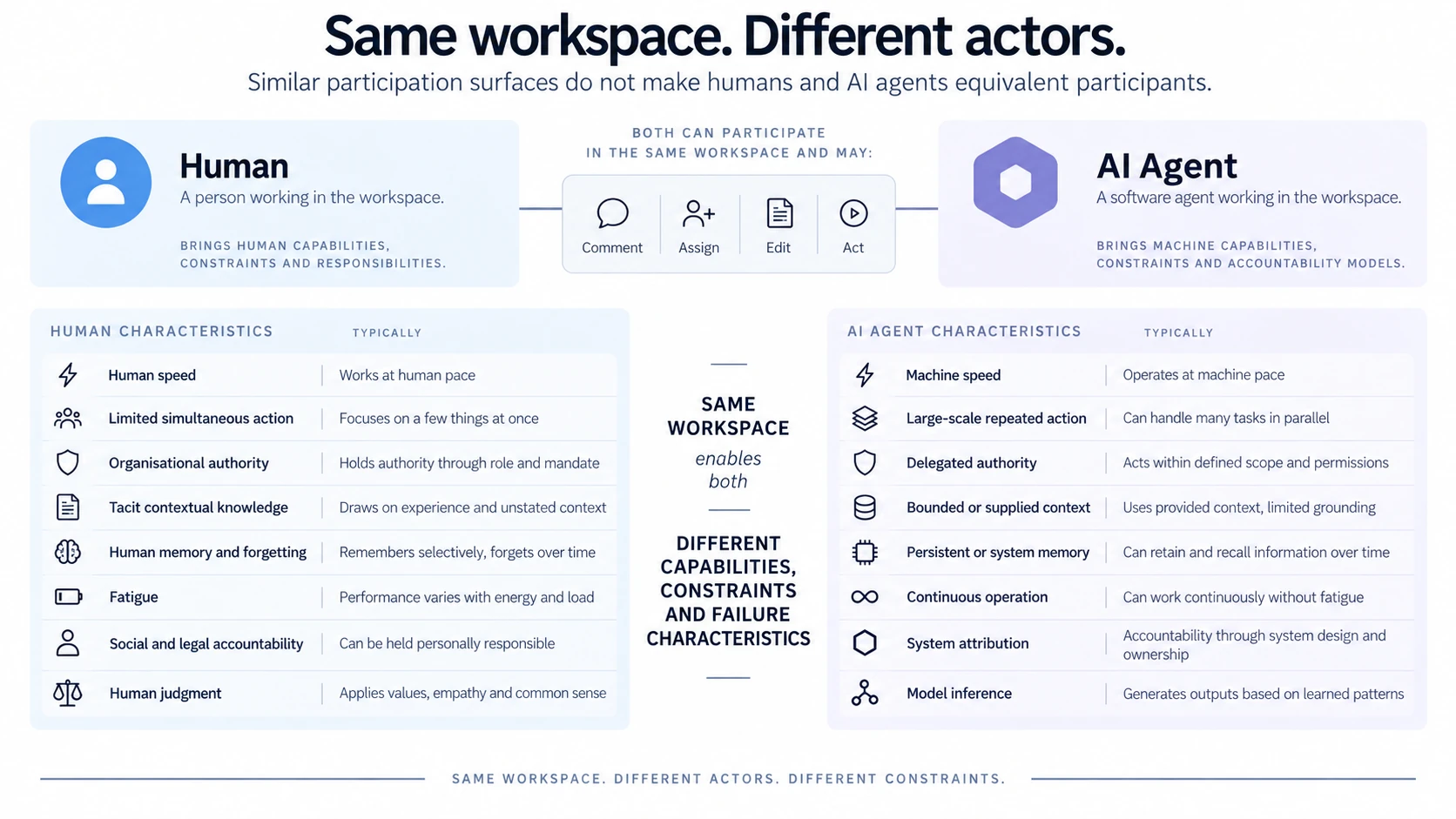
A human employee and an AI agent are not equivalent participants.
A human has organizational responsibilities, judgment, social relationships and legal accountability. A human gets tired, forgets things, occasionally misunderstands instructions and can act only at human speed.
An agent has very different characteristics.
It may operate continuously. It can replicate actions at enormous scale. It may preserve some forms of memory perfectly while misunderstanding something obvious to a person. It can act for several users, invoke other systems and potentially initiate thousands of operations before anyone notices that its interpretation was wrong.
Even identity works differently.
Current AWS guidance for agentic systems explicitly recommends keeping agent identities separate from human identities. Agent actions and human actions should remain distinguishable, permissions should be independently scoped and audit trails should make it unambiguous which kind of actor performed an operation. (AWS)
That tells us something important.
The future hybrid workplace cannot simply give an AI agent a user account, put a profile picture beside its name and treat the problem as solved.
The platform must recognize that different kinds of actors inhabit the same system.
That makes this less like adding another feature to collaboration software and more like creating an institution.
Institutions work because participants understand certain rules.
Who can do what?
Who owns what?
Whose instruction has authority?
What happens when participants disagree?
When does someone need consent?
What must be disclosed?
Who becomes responsible when something goes wrong?
Human organizations have developed answers to questions like these over centuries.
AI-first platforms may soon need their digital equivalents.
We know how to design permissions. We are still learning how to design coexistence.
Much of today’s agent governance understandably concentrates on permissions. Can the agent read this customer record? Can it update the CRM? Can it send an email? Can it issue a refund? Does it need approval before executing a transaction? These controls are essential. But permission is only one dimension of collaboration. Consider a project workspace containing three people and two agents. A human project manager creates a task. An AI research agent discovers new information and believes the task is no longer necessary. Should it close the task? Perhaps it has permission to do so. But permission does not tell us whether it should have the interaction authority to change work created by somebody else. Suppose instead the agent comments:
This task may no longer be necessary based on new evidence. Should it merely recommend the change? Should it request approval? Can it assign the review back to the original author? What if another agent disagrees? What if a human overrides both agents? Should that disagreement disappear from the workspace, or remain part of the decision history?
These are not only access-control questions. They are questions about interaction, coordination and the organisation of shared work. Enterprise software has long contained automation, rules engines and workflow logic. Much of that automation, however, operated through relatively predefined rules and processes, while human roles remained the dominant visible participants in collaborative work. Agentic systems make software-initiated action more flexible, persistent and visible inside the work environment itself, often extending it across systems. As that happens, platform design has to account not only for what actors are technically authorized to do, but for how they coordinate, exercise authority and affect one another’s work.
The idea isn’t entirely new
Human-computer interaction has explored related problems for decades. In 1999, Eric Horvitz described mixed-initiative interaction: systems in which humans and computers contribute according to what each is best suited to do at an appropriate moment. His work challenged the false choice between total automation and total human control, arguing instead for systems that combine the two. (Microsoft Research) More recent human–AI design guidance has made that relationship more concrete. Microsoft’s HAX Toolkit synthesizes research into guidelines and patterns for issues such as capability communication, timing, correction, uncertainty, explanation and user control. (Microsoft HAX Toolkit) Google’s People + AI Guidebook similarly provides methods, best practices and design patterns for human-centered AI. (Google PAIR) Platform and design-system guidance has also matured. Apple’s Human Interface Guidelines now include dedicated guidance for generative AI, including transparency, inputs, outputs, feedback and privacy. (Apple HIG) IBM’s Carbon for AI provides concrete interaction and component guidance for making AI presence, transparency and explainability legible inside products. (IBM Carbon for AI) These are not identical frameworks, and they operate at different levels of abstraction. Together, however, they show that substantial design knowledge already exists for the relationship between a person and an AI system. System-level thinking is not new either. Human-factors research on automation, CSCW, distributed cognition, cognitive systems engineering and human–agent teamwork have long examined coordination and interdependence across people, machines and work arrangements. (Parasuraman, Sheridan & Wickens, Schmidt & Bannon, Hutchins, Hollnagel & Woods, Klein et al.) What agentic platforms change is not the invention of this wider unit of analysis, but its growing relevance to mainstream software-product design. Multiple humans, agents and automated systems can now participate in, modify and hand off the same work inside everyday enterprise products. The practical unit of design may therefore need to expand beyond the individual human–AI encounter to include the work system in which multiple actors participate. That brings questions of ownership, delegation, decision authority, attribution, responsibility and accountability more directly into product design—not as entirely new questions, but as increasingly visible and consequential ones. The issue is no longer only how an AI system should behave toward a user. It is also how the work environment structures relationships among multiple actors.
Think of it as a Shared Interaction Contract
A useful way to think about this is as a Shared Interaction Contract. Not necessarily a literal document or technical protocol, and not a replacement for established human–AI interaction guidelines. It is a platform-level interaction layer: the rules that govern relationships among actors when more than one kind of participant can initiate, modify, delegate or complete shared work. It answers:
How are actors expected and permitted to behave toward one another while participating in shared work?
The distinction matters. A system prompt governs an agent’s behaviour. A permission model determines what resources an actor can technically access or modify. A business rule specifies organizational constraints: for example, refunds above a certain value require managerial approval. A workflow determines how work progresses through stages. A Shared Interaction Contract governs the relationships among participants operating inside those systems. Who may initiate? Who may interrupt? Who can delegate to whom? Who can change another actor’s work? When is acknowledgement required? When does recommendation become action? Who can contest a decision? When must an agent reveal why it acted? What happens when instructions conflict? And perhaps most importantly: Who owns the outcome?
Some rules should be the same
There are good reasons not to create entirely separate worlds for human and AI activity. Certain platform principles should probably apply to every actor.
Identity
Every meaningful participant should have an identifiable identity. A user should know whether an action originated from a person, an agent, an automated workflow or an agent acting on behalf of someone else. “AI changed this record” will not be sufficient. Which AI? Acting independently or for whom? Using what authority?
Provenance
Material changes should retain their origin. If a proposal evolves through a human draft, an agent rewrite, another human correction and an autonomous update triggered by new data, the system should preserve enough lineage to reconstruct that evolution.
Ownership
Work should have understandable ownership regardless of whether its current owner is human or artificial. Who is working on this? Who is waiting for whom? Who has responsibility for the next move?
State
The meaning of common states should remain coherent. Draft. Proposed. Approved. Assigned. Completed. Rejected. Blocked. If an agent interprets “approved” differently from a human, the platform has failed regardless of how intelligent either participant is.
History
Consequential actions should leave a trace. Humans shouldn’t be able to erase inconvenient decisions through informal side channels while agents are expected to maintain perfect audit trails. Equally, agent actions should not disappear into invisible orchestration logs unavailable to the people affected by them. These are examples of symmetric rules. Different actors, same underlying interaction principle.
But many rules should deliberately be different
Symmetry becomes dangerous when it is mistaken for equality. Giving humans and agents identical treatment may actually produce less trustworthy systems. Consider initiative. A colleague may notice something unusual and send me fifteen messages during a day. Annoying perhaps, but manageable. An agent monitoring thousands of signals could potentially interrupt me hundreds of times. So the human and the agent may both have the ability to initiate interaction, while the platform applies very different thresholds to that ability. The same applies elsewhere.
Authority
A human manager may have authority derived from an organizational role. An agent’s authority may need to be explicitly delegated and tightly scoped.
Irreversibility
A human might be allowed to execute a consequential action directly. An agent performing the same action may require confirmation because its failure characteristics are different.
Explanation
Organizations rarely require employees to document the reasoning behind every trivial action. An autonomous agent might face stronger provenance requirements because humans need ways to inspect behaviour occurring beyond continuous supervision.
Scale
A person might be permitted to update customer records individually. An agent capable of updating 100,000 records may require a different rule even if the underlying operation is identical.
Override
Humans may require authority to halt an agent immediately. The reverse relationship is unlikely to be symmetrical.
Uncertainty
An agent may need to surface uncertainty or request clarification at thresholds that have no direct equivalent for human employees. These are asymmetric rules. And this may be the principle AI-first platform design needs to internalize:
Fair collaboration does not require identical treatment. It requires rules appropriate to the capabilities, limitations and responsibilities of each participant. Same rulebook. Different rules.
These symmetric and asymmetric rules are an initial design proposition, not a complete framework. The point is not that every AI-first platform should adopt this exact set, but that platforms need an explicit model for deciding which principles are shared across actors and where different capabilities, risks and responsibilities require different implementations.
The interface will have to communicate far more than it does today
This has consequences for UX.
Traditional interfaces predominantly help a user answer questions such as:
What can I do here?
Where can I find something?
What happens if I click this?
AI-first environments introduce another class of questions:
Who is doing this?
Why did they start doing it?
Are they suggesting something or executing it?
On whose authority are they acting?
Who currently owns this work?
Can I interrupt them?
Will they continue if I leave?
Did a person approve this?
What happens if I disagree?
Has this decision already propagated elsewhere?
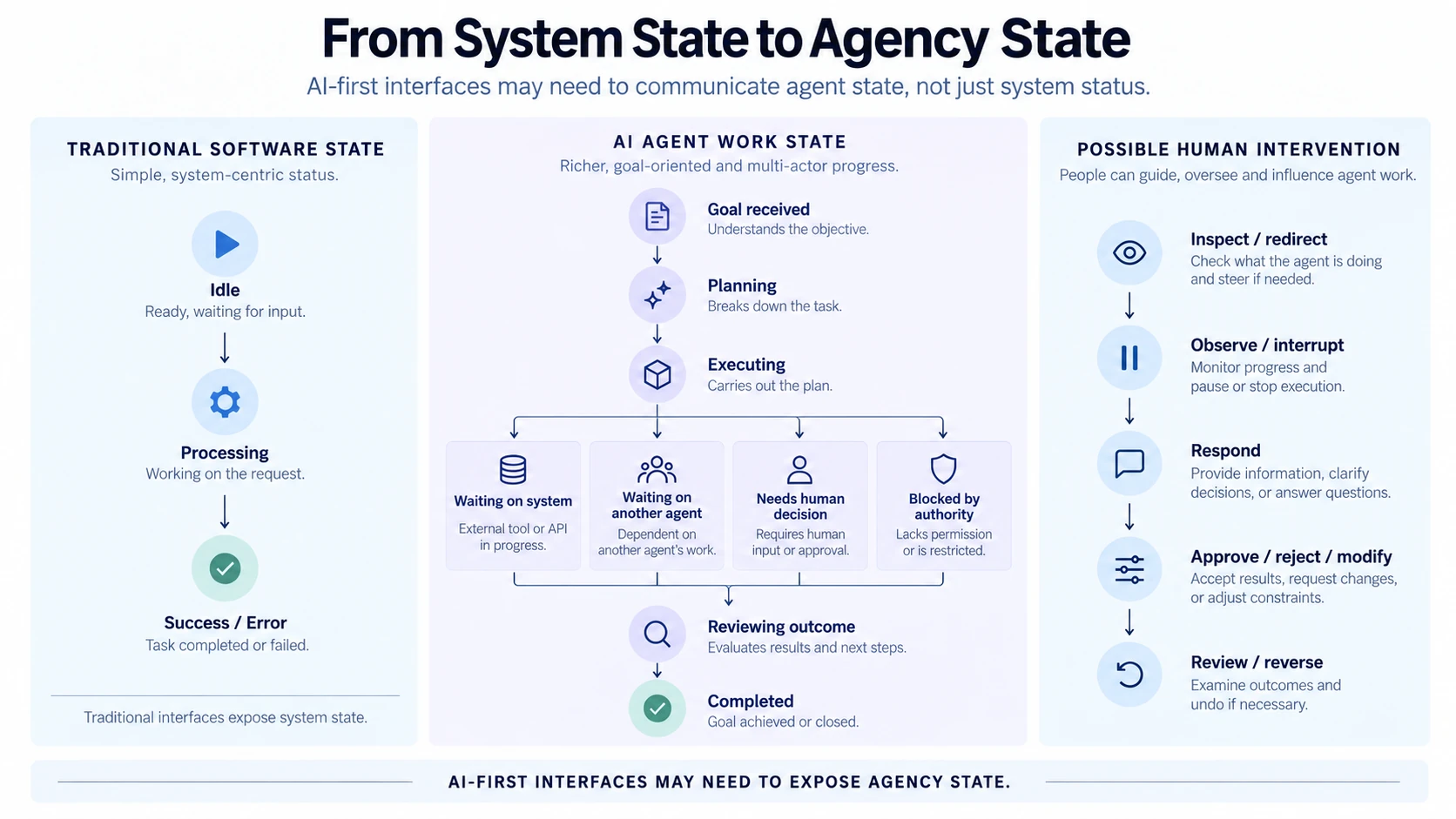
These are not simply interface-state questions.
They are agency-state questions.
 Our existing UI vocabulary may prove inadequate for them.
A spinner tells us that the computer is processing something.
What should represent an agent that has accepted a goal, created a plan, delegated two subtasks, is awaiting an external response and intends to continue acting after the user logs out?
A greyed-out button communicates lack of access.
What should communicate that an agent technically can perform an action but lacks delegated authority to do so without asking?
A document’s edit history records what changed.
What should an interaction history show when an agent changed something because another agent instructed it to, acting under authority delegated three weeks earlier by a human?
These may eventually require new interface primitives.
Not because AI needs a futuristic visual language.
Because distributed agency needs to become legible.
Handoffs illustrate the problem particularly well
Human-in-the-loop adds a point of oversight, but its presence alone does not guarantee meaningful control.
A handoff is not simply a routing event.
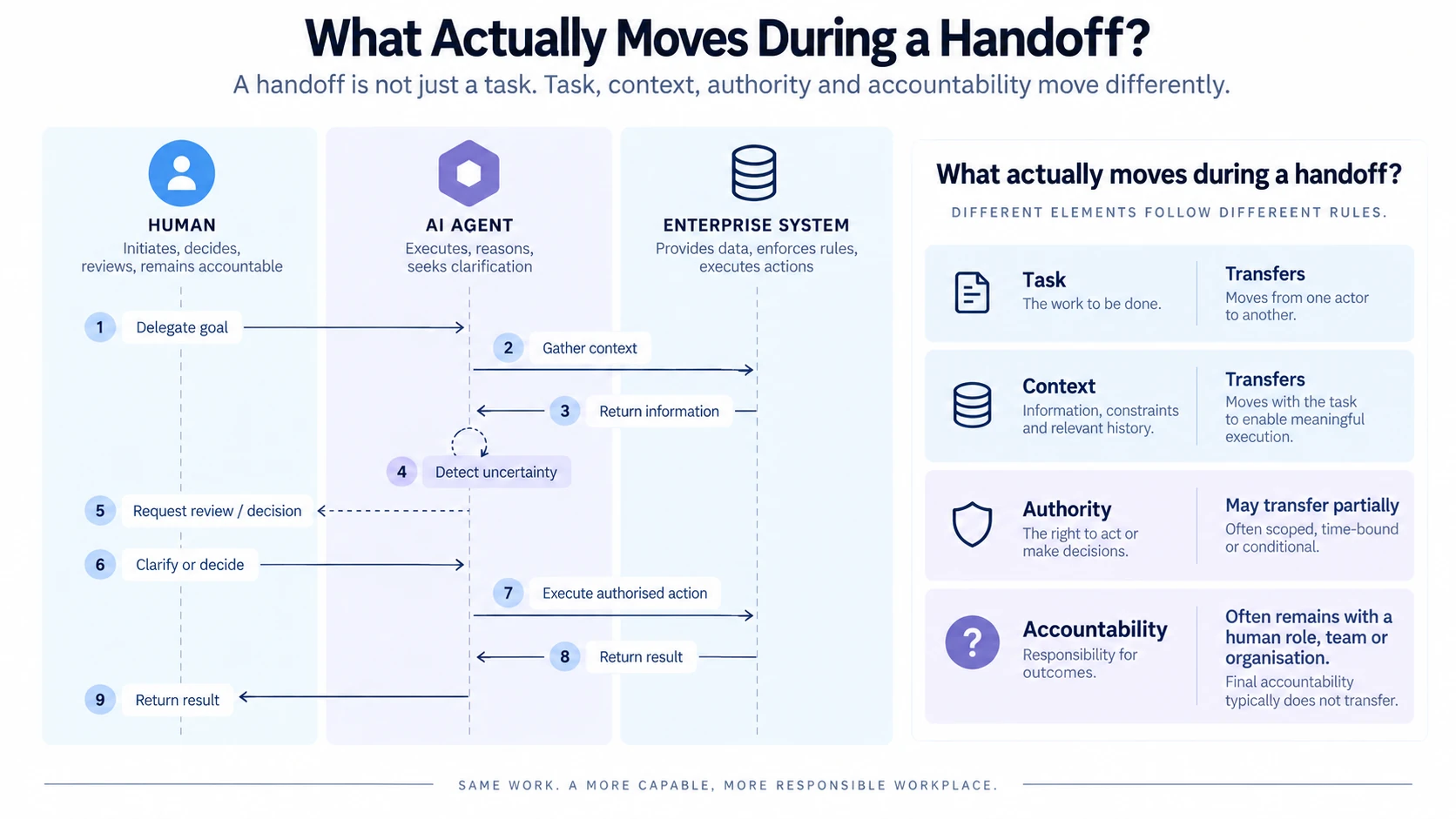 When an agent hands work to a human, what exactly transfers?
The task?
Context?
Decision authority?
Accountability?
A recommendation?
A partially completed action?
The reasons the agent became uncertain?
And when the human gives the work back, what has the agent learned?
Does it resume the original plan?
Does the human’s intervention permanently change its future behaviour?
Can the human modify the goal without explicitly telling the agent?
Current products are already exposing fragments of these questions. Microsoft’s Channel Agent, for example, can generate meeting summaries that humans may approve or reject; if nobody acts, summaries may automatically be shared after a defined period. That tiny interaction already contains rules about initiative, review, timeout and authority. (Microsoft Support)
As agent participation expands, thousands of such decisions will have to be made.
Individually designed exceptions will eventually become inconsistent.
Platforms will need principles.
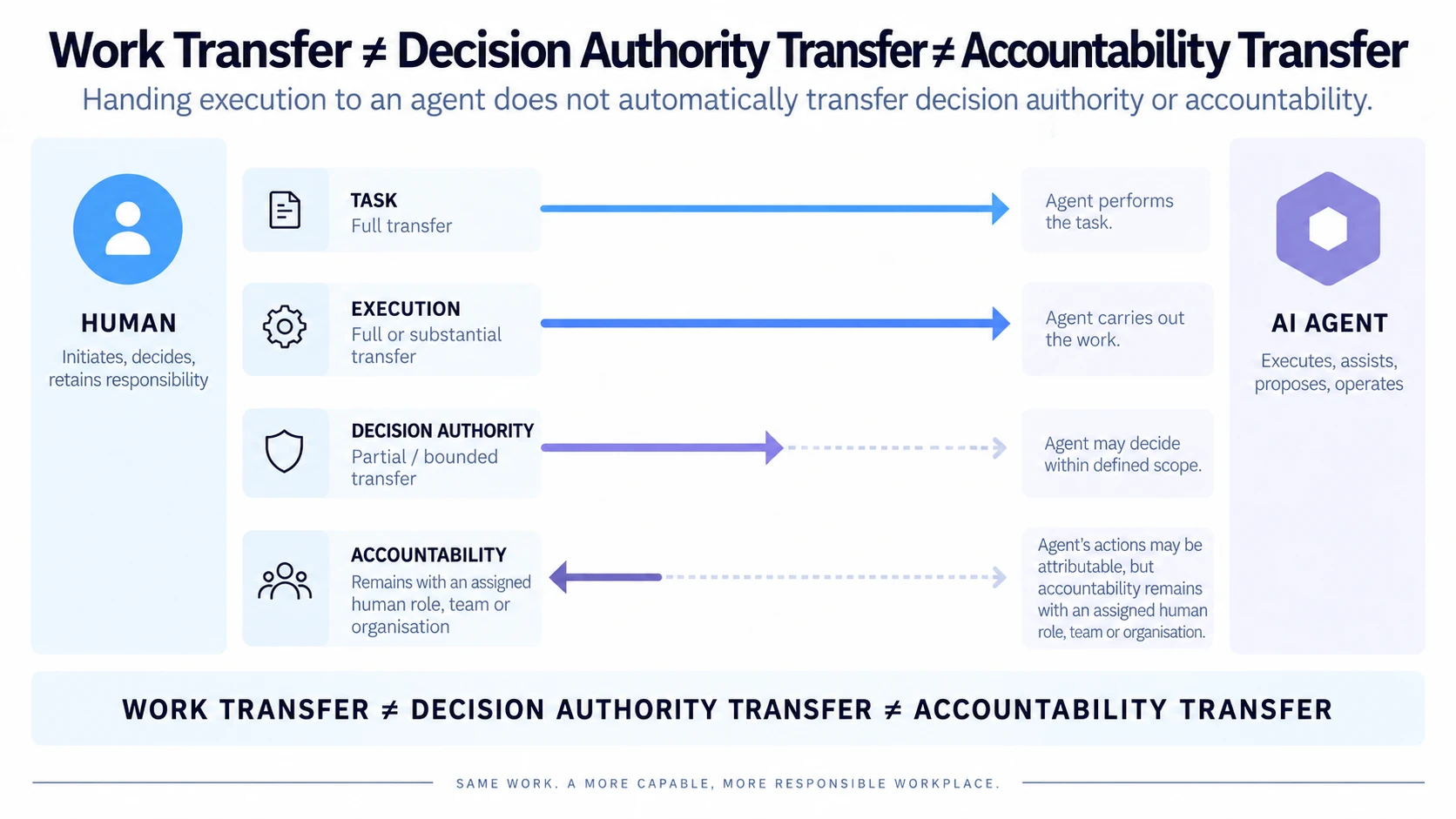
AI-first platforms may need constitutions, not merely guardrails
The word guardrail has become ubiquitous in AI.
Guardrails are useful.
But the metaphor is revealing.
A guardrail sits at the boundary and stops something from leaving the road.
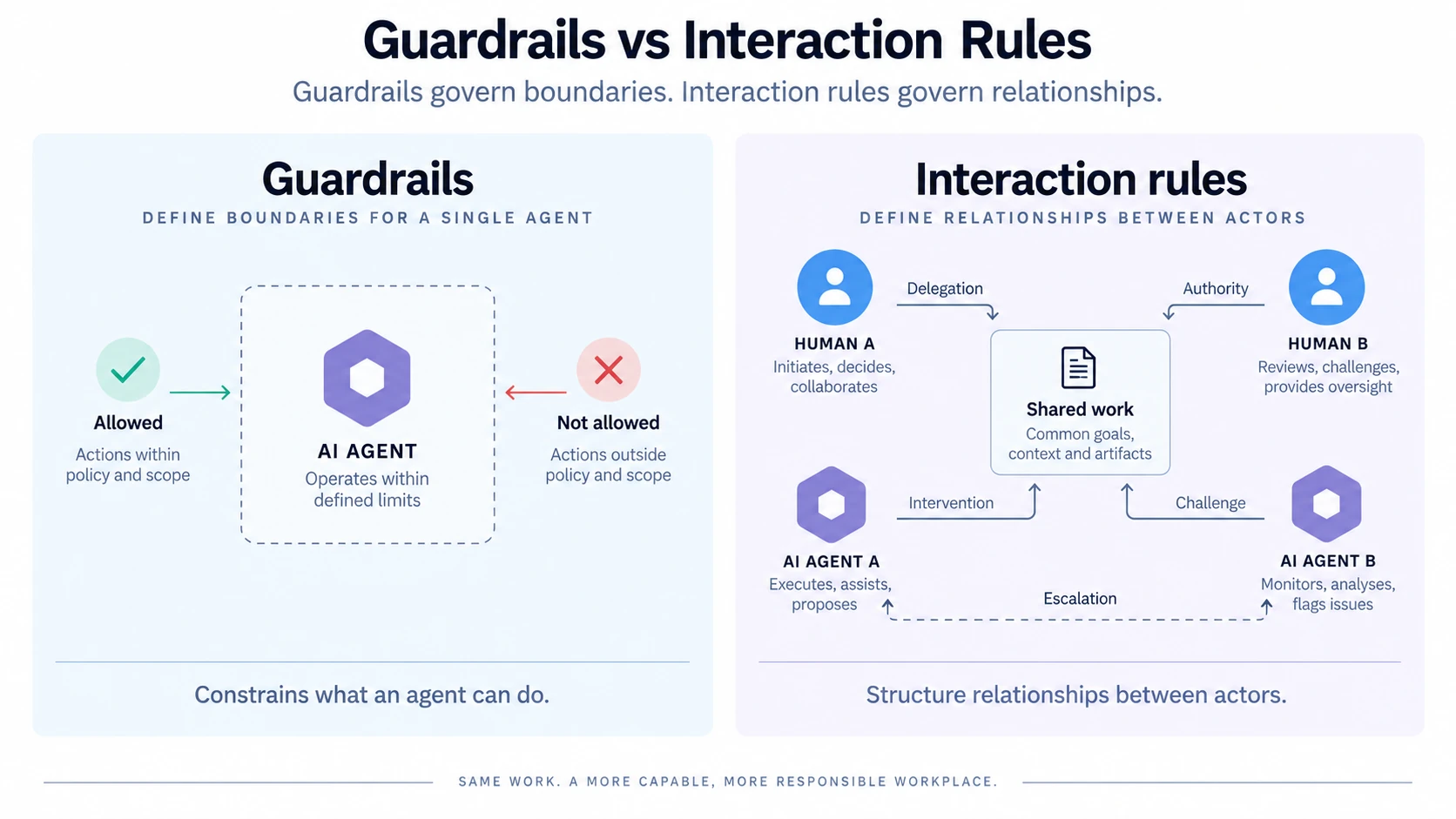 Collaboration requires considerably more than boundaries.
A functioning workplace doesn’t operate because everybody knows what they are prohibited from doing.
It works because participants also understand roles, authority, expectations, conventions, escalation paths, ownership and responsibilities toward one another.
AI-first platforms may need something closer to this institutional layer.
A constitution is perhaps too grand a word, but the analogy is useful.
A constitution does not instruct every participant to behave identically.
It establishes a common structure within which different actors hold different powers, responsibilities and constraints.
Perhaps AI-first platforms will need the same.
Not:
One behaviour model for humans and another for agents.
But:
One coherent interaction system capable of governing both.
The real design question isn’t whether AI becomes a coworker
Whether we call them coworkers, copilots, agents, assistants or digital employees may ultimately matter less than the operational reality. Software systems are acquiring participants capable of exercising agency. Once they do, the old distinction between user and system becomes harder to sustain. There may instead be multiple actors: humans, agents representing humans, agents representing organizational functions, specialized agents collaborating with other agents, background automation, and systems responsible for governing all of them. The challenge will not simply be making each agent more capable. The challenge will be making the behaviour of the whole environment understandable. A high-performing agent inside a poorly designed interaction system can still produce a dysfunctional workplace. That makes the next generation of collaboration-platform design as much a question of institution design as interface design. We will need to decide: Who gets initiative. Who receives authority. How authority travels. How work changes hands. How disagreements surface. How actions remain attributable. How humans regain control. How autonomous work becomes visible. And how responsibility survives all of those transitions. AI-first platforms therefore need more than agents that understand their instructions. They need environments in which every participant can understand the rules of participation. Humans and AI agents do not need to become equals. They do not need identical permissions. They do not need identical responsibilities. And pretending that they are simply interchangeable coworkers may create more confusion than clarity. What they do need is a common system within which their differences are explicit, deliberate and understandable. One workplace. Multiple kinds of actors. Same rulebook. Different rules.